
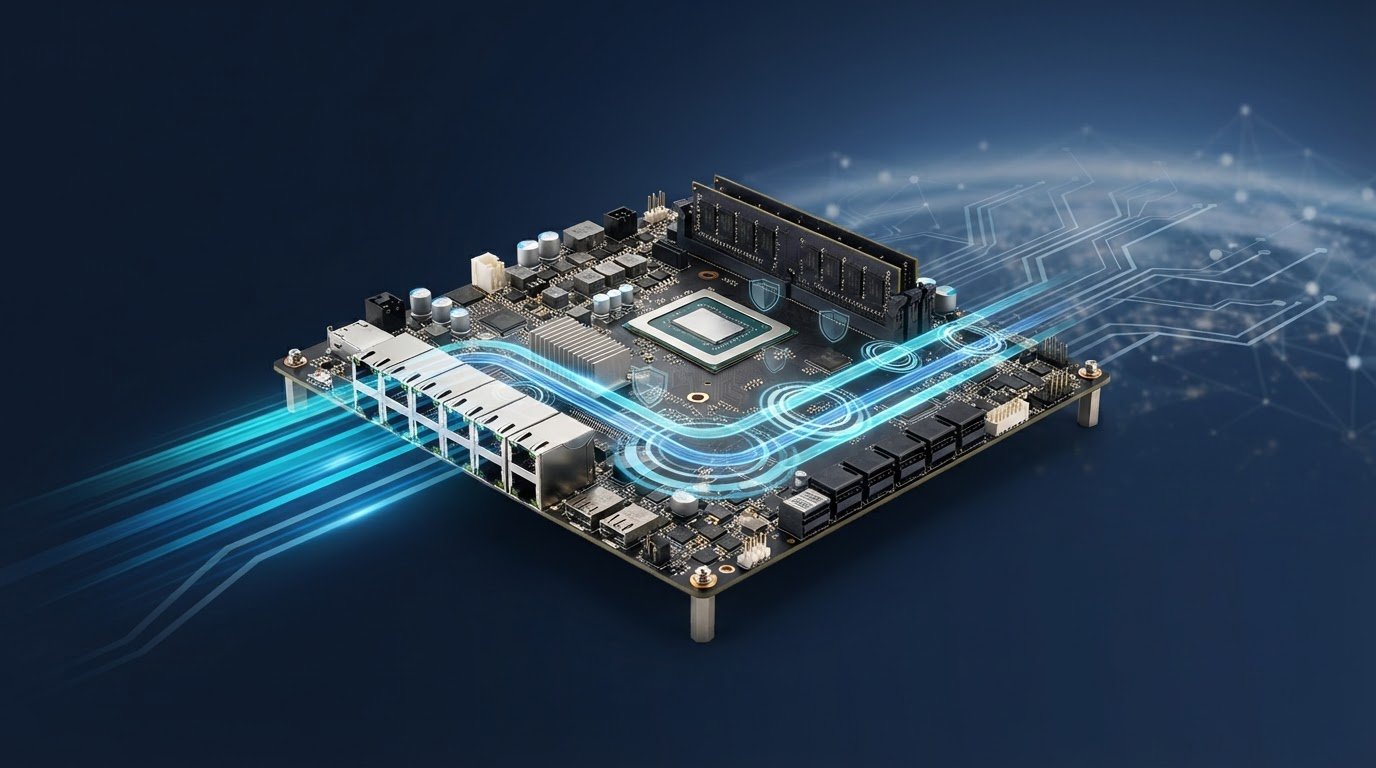
How to Integrate a Real Time Packet Inspection Engine into Gateway Firmware
Enabling Layer 7 visibility on embedded gateway hardware doesn't have to destroy network throughput. If you've ever integrated an inspection daemon only to watch CPU usage spike and forwarding rates collapse, you know the frustration. Bolting an unoptimized real time packet inspection engine into user space inevitably introduces latency, drains memory, and stalls traffic across networking SoCs like Broadcom, Qualcomm, and MediaTek.
You shouldn't have to sacrifice line-rate forwarding just to gain granular security and application control. In this guide, you'll learn how to evaluate, embed, and optimize an in-kernel inspection architecture built for high-throughput network gateways. We'll examine core embedded requirements, review cross-compilation workflows, and walk through the technical steps required to seamlessly integrate a real-time engine into your gateway Linux firmware.
Key Takeaways
- Discover why running a real time packet inspection engine inside the Linux kernel eliminates user-space latency while preserving wire-speed throughput.
- Understand how deterministic, single-pass pattern matching inspects Layer 7 payloads without overwhelming embedded CPU resources.
- Learn the technical steps to align cross-compilation toolchains and configure driver load orders before network interfaces bridge.
- Master signature memory optimization techniques across diverse networking SoCs, including Broadcom, Qualcomm, and MediaTek architectures.
Table of Contents
- Architectural Foundations of a Real Time Packet Inspection Engine
- How to Integrate an Embedded Packet Inspection Engine into Router Firmware
- Optimizing Engine Performance Across Diverse Network SoC Architectures
Architectural Foundations of a Real Time Packet Inspection Engine
Modern gateway firmware requires continuous traffic visibility without throttling throughput. At its core, a real time packet inspection engine reconstructs Layer 4 TCP and UDP sessions to inspect Layer 7 payloads deterministically. Rather than running separate passes for protocol classification and security filtering, an optimized engine applies single-pass pattern matching. This unified architecture concurrently classifies protocol metadata, identifies application signatures, and detects malicious payload fragments across raw byte streams. By transforming complex rule graphs into deterministic finite automata, deterministic regex algorithms prevent exponential state explosion and guarantee predictable execution times regardless of traffic composition.
Foundational Deep Packet Inspection (DPI) architectures often struggle with flow reassembly when handling fragmented or out-of-order IP packets. A deterministic engine solves this by maintaining minimal stream-tracking contexts, inspecting traffic inline without buffering entire files.
Kernel Space Versus User Space Processing Bottlenecks
Traditional user-space daemons severely handicap gateway throughput. Copying packets across the boundary via Netlink sockets introduces intense context-switching overhead that exhausts embedded CPUs. A production-grade real time packet inspection engine operates as a Linux kernel module binary, processing sk_buff structures directly inside the native network stack.
- Eliminates memory copies: In-kernel inspection reads packet payloads in place.
- Minimizes forwarding latency: Decisions execute synchronously before packets enter bridging or routing tables.
- Conserves CPU cycles: Bypassing user-space scheduling leaves processing headroom for core gateway tasks.
How to Integrate an Embedded Packet Inspection Engine into Router Firmware
Successful firmware integration requires strict alignment between target SoC toolchains and underlying kernel module dependencies. Before flashing production images, validating the kernel build environment against the vendor board support package ensures symbols, endianness, and ABI flags match precisely. Startup scripts must initialize and insert the real time packet inspection engine before network bridges link up, preventing uninspected packets from bypassing inspection during system initialization.
Execution Workflow from Evaluation Board to Production Image
Transitioning from prototype to deployment across modern System-on-Chip (SoC) devices follows a structured, three-phase engineering sequence:
- Initialize the reference hardware: Boot the vendor Evaluation Board (EVB) with the manufacturer-supplied embedded Linux SDK, validating cross-compiler toolchain versions, kernel headers, and symmetric multiprocessing (SMP) configurations.
- Cross-compile the kernel module binary: Build the engine module to match target processor flags and inject it into the root filesystem, configuring initialization scripts to load drivers prior to interface activation.
- Establish IPC control channels: Bind lightweight user-space management daemons to the kernel module through dedicated Netlink sockets, passing filtering rules, security updates, and telemetry commands dynamically.
This staged approach separates high-speed payload inspection from configuration logic, preserving wire-speed packet processing. If your team is preparing to deploy Layer 7 application visibility and control across heterogeneous gateway platforms, contact our integration specialists to review board support package compatibility and evaluation workflows.
Optimizing Engine Performance Across Diverse Network SoC Architectures
Memory constraints vary dramatically across commercial router silicon, from low-power consumer CPEs to multi-core enterprise appliances. Maximizing throughput from an embedded real time packet inspection engine requires tailoring active rule sets to local RAM capacity rather than loading complete databases indiscriminately. Pruning dormant categories and structuring pattern trees around active network traffic preserves CPU cache locality. Gateway appliances like the Pico-UTM 100 demonstrate wire-speed inspection through optimized firmware architecture, proving that compact hardware can maintain gigabit throughput when inspection structures fit available system memory.
Dynamic Signature Distribution and Memory Footprint Tuning
Deploying updates across heterogeneous hardware fleets demands intelligent distribution. Implementing hybrid cloud pipelines allows gateways to fetch selective signature packages, such as consumer streaming profiles or industrial protocols like ModBus and IEC104. Academic research into an in-network deep packet inspection framework highlights the performance dividends of aligning inspection tables directly with hardware memory bounds.
- Shadow memory compilation: Compile incoming pattern trees in isolated RAM before swapping runtime pointers atomically to prevent packet stalls.
- Automated rollback safeguards: Protect gateway uptime by triggering instant fallback routines if database synchronization fails or exceeds memory thresholds.
- Protocol-focused optimization: Restructure pattern matching depth across HTTP/HTTPS, QUIC, and SCADA streams to sustain line-rate forwarding.
Consult network security specialists at Lionic Engineering for tailored evaluation board integration support across Broadcom, Qualcomm, MediaTek, and Realtek architectures.
Deliver Wire-Speed Intelligence to Your Gateway Firmware
Embedding a real time packet inspection engine directly into the Linux kernel bridges the gap between deep application visibility and line-rate forwarding. Utilizing a patented deterministic regex pattern matching algorithm enables gateway firmware to eliminate user-space latency while maintaining stream reassembly. With turnkey support across Qualcomm, Broadcom, MediaTek, and Realtek SoCs, engineering teams can deploy granular Layer 7 application control without costly hardware redesigns. Over 2 million commercial DPI SDK deployments worldwide prove that comprehensive threat inspection and tight embedded constraints can succeed together.
Accelerate your firmware development with Lionic integration expertsEquipping your gateway fleet with proven in-kernel intelligence guarantees that your devices deliver advanced security without sacrificing packet forwarding performance.
Frequently Asked Questions
What is the difference between shallow and real-time deep packet inspection?
Shallow packet inspection examines only Layer 2 through Layer 4 packet headers, whereas a real time packet inspection engine evaluates full Layer 7 payload streams. Shallow inspection can't detect malicious payload fragments or identify applications masking behind port 443. Deep inspection reconstructs continuous byte streams inline to classify application signatures and intercept network attacks deterministically.
How much memory does an embedded packet inspection engine require in router firmware?
Memory requirements depend on the active database profile, but embedded engines typically operate within 32 MB to 256 MB of RAM. Modular architecture allows developers to provision targeted signature subsets tailored to hardware constraints. Residential gateways can load compact application profiles, while higher-tier appliances load broader signature databases without depleting local system memory.
Can a packet inspection engine analyze encrypted traffic protocols like HTTPS and QUIC?
Yes, an embedded engine analyzes encrypted sessions by inspecting initial handshake metadata, TLS Server Name Indication fields, and behavioral traffic dynamics. When protocols like TLS 1.3 conceal connection metadata, the engine classifies traffic using packet sizing, sequence order, and timing analysis. Gateway firmware can also integrate dedicated TLS proxy modules if deep plaintext payload decryption is necessary.
Does integrating a packet inspection engine increase network forwarding latency?
A kernel-native real time packet inspection engine introduces negligible, sub-millisecond latency to network forwarding paths. Executing within the Linux kernel avoids user-space context switches by inspecting sk_buff structures in place. Deterministic single-pass algorithms evaluate entire packet payloads in one cycle, ensuring gateways sustain wire-speed throughput without stalling traffic queues.